Sep 18, 2026Buying Guides
Barcode Scanners, RFID or Image-Based Code Readers: Choosing Identification Technology
1D codes, 2D serialization or contactless RFID? How to choose the right identification technology for traceability and sortation.
Three ways to give an object an identity
Automated identification is the backbone of traceability, sortation and intralogistics. Three technologies dominate: laser barcode scanning, RFID and image-based code reading. They differ in line of sight, data capacity and how they handle damaged or invisible codes.
Laser barcode scanning: fast and proven
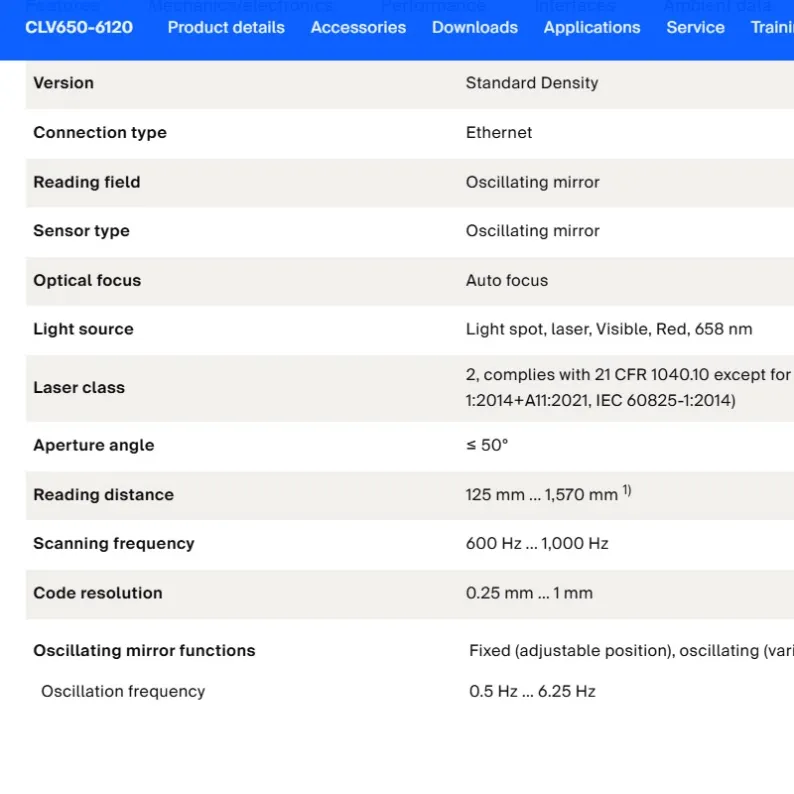
Fixed-mount laser scanners read 1D barcodes on moving products with high line speeds. Autodynamics adapt to changing conveyor speeds, and modern decoders reconstruct damaged or low-contrast codes. For carton identification on sorters and goods tracking in warehouses, scanners such as the SICK CLV650-6120 and SICK CLV630-1120 remain the efficient default.
Image-based code reading: 2D codes and verification
When codes become 2D - DataMatrix, QR - or when the process must verify print quality, camera-based readers take over. Devices such as the SICK V2D611R-MMSBE4 and SICK V2D621P-2MSFBB5 capture an image, decode it, and report quality feedback that supports serialization and track-and-trace compliance in pharmaceutical and electronics production.
RFID: identity without line of sight
RFID reads and writes tags without optical contact - the tag can sit inside packaging or under a carrier surface. This makes it ideal for reusable transport items, tool identification and route control on AGVs. HF read/write devices such as the SICK RFU620-10505 update tag data directly on the line, turning carriers into mobile data stores.
Color, contrast and luminescence: marks instead of codes
Not every identification task needs a code. Color sensors distinguish product shades for sorting, contrast sensors detect print marks for registration on packaging webs, and luminescence sensors verify invisible UV marks and adhesive beads. These compact sensors solve high-speed verification tasks that cameras and scanners are not designed for.
Quick selection checklist
- 1D codes on conveyors: fixed-mount laser scanner.
- 2D codes, serialization, quality feedback: image-based code reader.
- No line of sight, read and write, reusable carriers: RFID.
- Print mark registration: contrast sensor.
- Invisible marks and adhesives: luminescence sensor.
Frequently Asked Questions
Can RFID replace barcodes completely?
It replaces them where contactless reading and writable memory matter. For printed consumer packaging, barcodes remain the economical standard.
Do image-based readers need external lighting?
No, integrated illumination provides consistent imaging; only extreme ambient light needs attention during setup.
Which technology survives a dirty environment best?
RFID - no optics are involved, so dust on the tag barely affects the read.
Next steps
Compare barcode scanners, RFID devices, code readers and mark sensors in our identification systems category and match the technology to your traceability task.