Sep 18, 2026Buying Guides
Safety Light Curtains and Safety Scanners: A Practical Selection Guide
Resolution, protective field height and safety levels explained - how to select light curtains, scanners and evaluation units for machine safety.
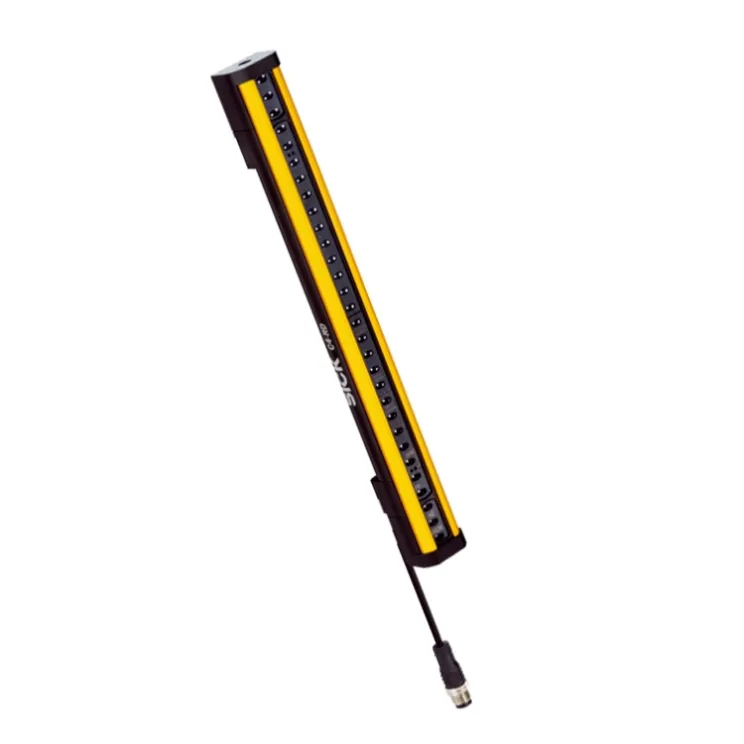
What a safety light curtain actually does
A safety light curtain creates a protective field of infrared beams between a sender and a receiver. When a person or object interrupts the field, the output circuit opens and the machine executes its safe stop. The key selection parameters are protective field height, resolution, and the safety level the application requires.
Resolution defines what is detected
Resolution describes the smallest object the curtain reliably detects. A 30 mm resolution curtain detects a hand or arm and is typically used for body and access protection. A 14 mm resolution curtain detects fingers and suits hazardous point protection close to the danger zone. Matching resolution to the risk assessment is the first decision, before any model number.
Hazardous point protection: the economical case
For compact machines where only the point of operation needs guarding, an economical Type 4 curtain such as the C4-RD family keeps cost down without giving up safety. Units like the SICK C4C-EC07530A10000 receiver and its matching SICK C4C-SC07530A10000 sender cover protective field heights from 150 mm upward in 50 mm steps, with no blind zones and slim mounting brackets for tight machine openings.
Body protection and access guarding
Where whole-body access must be detected - for example on palletizing lines or large machine openings - coarser resolutions and taller fields are used. Light grids such as the M2000 Standard family (SICK M20E-02150A122) detect a person entering at body height, while single-beam sensors like the SICK L41E-33MA2A cover individual access points economically.
When a scanner beats a curtain
Light curtains monitor a flat plane between two bars. Irregular hazard zones, AGV surroundings and changing field shapes call for safety laser scanners, which monitor configurable 2D areas. The microScan3 family (SICK MICS3-AAAZ40AZ1P01) and the compact S30B platform (SICK S30B-2011BA) cover stationary and mobile applications, and radar-based systems extend monitoring to dusty or outdoor conditions.
Evaluation: relays or a safety controller
The curtain or scanner outputs must be evaluated by the safety circuit. Small machines often use safety relays such as the ReLy family (SICK RLY3-EMSS100, SICK RLY3-OSSD100 for OSSD signals). Machines with several safety functions benefit from a modular controller like the SICK UE410-MU3T5, which replaces complex relay wiring with configured logic.
Frequently Asked Questions
Can I mix a 14 mm sender with a 30 mm receiver?
No - sender and receiver must share the same protective field height and resolution to form a matched pair.
How do I calculate the safety distance?
The distance depends on stopping time of the machine, the curtain response time, and intrusion allowance per the applicable standards. Always derive it from the machine risk assessment.
Curtain or scanner for a robot cell?
If the hazard zone has a regular shape and fixed geometry, curtains are cost-effective. For irregular zones, shared spaces or mobile equipment, scanners are the better fit.
Next steps
Explore the full range in our safety sensors category - light curtains, laser scanners, safety switches, relays and controllers for complete machine safety concepts.