Sep 18, 2026Buying Guides
Rotary and Linear Encoders: A Practical Selection Guide
Absolute or incremental, hollow shaft or solid, magnetic or optical? A practical guide to choosing encoders for drives and machine axes.
What an encoder tells the drive
Encoders convert mechanical motion into electrical signals that drives and controllers use for speed, position and commutation. The two basic families - rotary and linear - answer different questions: rotary encoders measure shaft angle, linear encoders measure position along an axis. Within each family, the decisive choice is absolute versus incremental.
Absolute or incremental?
Incremental encoders output pulses per revolution or per distance unit. The controller counts them, which delivers excellent speed feedback but only relative position - after power-up the axis must reference. Absolute encoders report a unique position value for every angle or location, so the machine knows where it is immediately at power-up, with no homing move. For axes where downtime for referencing is costly, absolute technology pays back quickly.
Rotary encoders: shaft, bore and interface
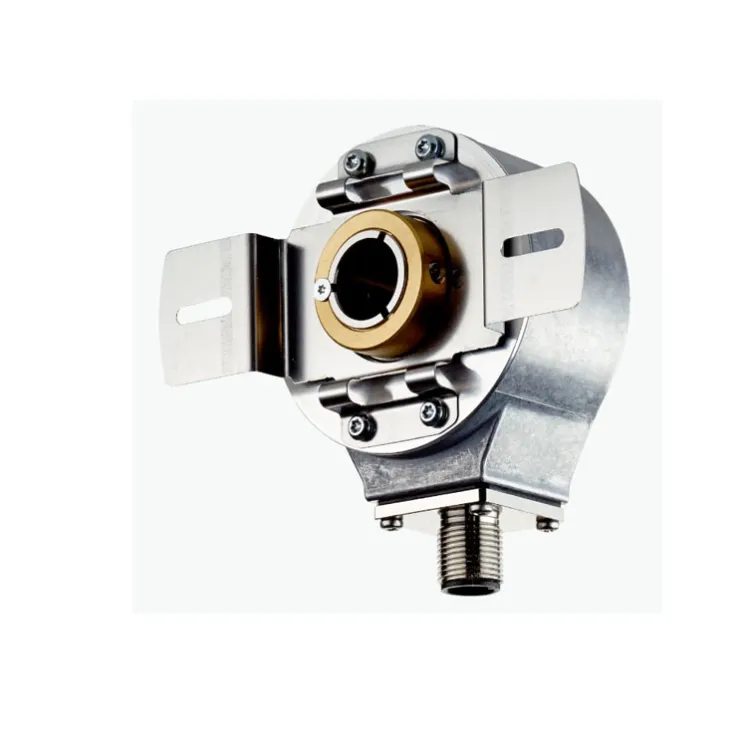
Rotary encoders mount either with a solid shaft and coupling, or as a hollow-shaft unit sliding directly over the motor shaft. Absolute single-turn feedback with 262144 positions per revolution, as provided by the SICK AFS60A-S4NB262144, suits servo axes that must know their position at every moment. Incremental hollow-shaft workhorses such as the SICK DBS60E-BGAC02048 (2048 pulses per revolution) and the economical SICK DBS36E-BBEK00100 cover standard drive feedback, and solid-shaft families like the SICK DLS40E-S3AV00360 integrate via coupling into existing machines.
Servo feedback: more than counting pulses
Servo drives need commutation information in addition to speed. SinCos feedback encoders such as the SICK SRS50-HZA0-S21 deliver analog signals that the drive interpolates to very high resolution, keeping commutation smooth and precise.
Linear encoders: position along the axis
Linear encoders read a scale along the axis of travel. Magnetic tape systems such as the SICK TTK70-HXA0-K02 and SICK KHK53-AXB00548 tolerate dust, oil and vibration that would blind optical scales, making them ideal for machine tools and linear motors. Absolute magnetic versions with a HIPERFACE interface, like the SICK L230-P580C2S00000, report exact position immediately at power-up.
Quick selection checklist
- Need position at power-up without homing: absolute encoder.
- Speed feedback on a standard drive: incremental, matched pulse count.
- Servo commutation: SinCos or absolute servo feedback with the drive's interface.
- Dirty environment on a linear axis: magnetic linear encoder.
- Motor mounting without coupling: through hollow shaft.
Frequently Asked Questions
Can I replace an incremental encoder with an absolute one?
Only if the drive supports absolute feedback. The benefit is no homing cycle and higher position integrity.
How many pulses per revolution do I need?
Enough that the controller resolves the required speed and position granularity - 1000 to 2048 ppr covers most standard drives.
Why does my magnetic linear encoder read reliably in a dirty shop?
Magnetic scanning does not depend on a clean optical path, which is exactly why it is preferred on machine tools.
Next steps
Compare absolute, incremental and linear families in our encoders category and match interface, resolution and mounting to your drive.